



Why Shopify 1.0 Stores Should Upgrade to Shopify 2.0
- MM Team
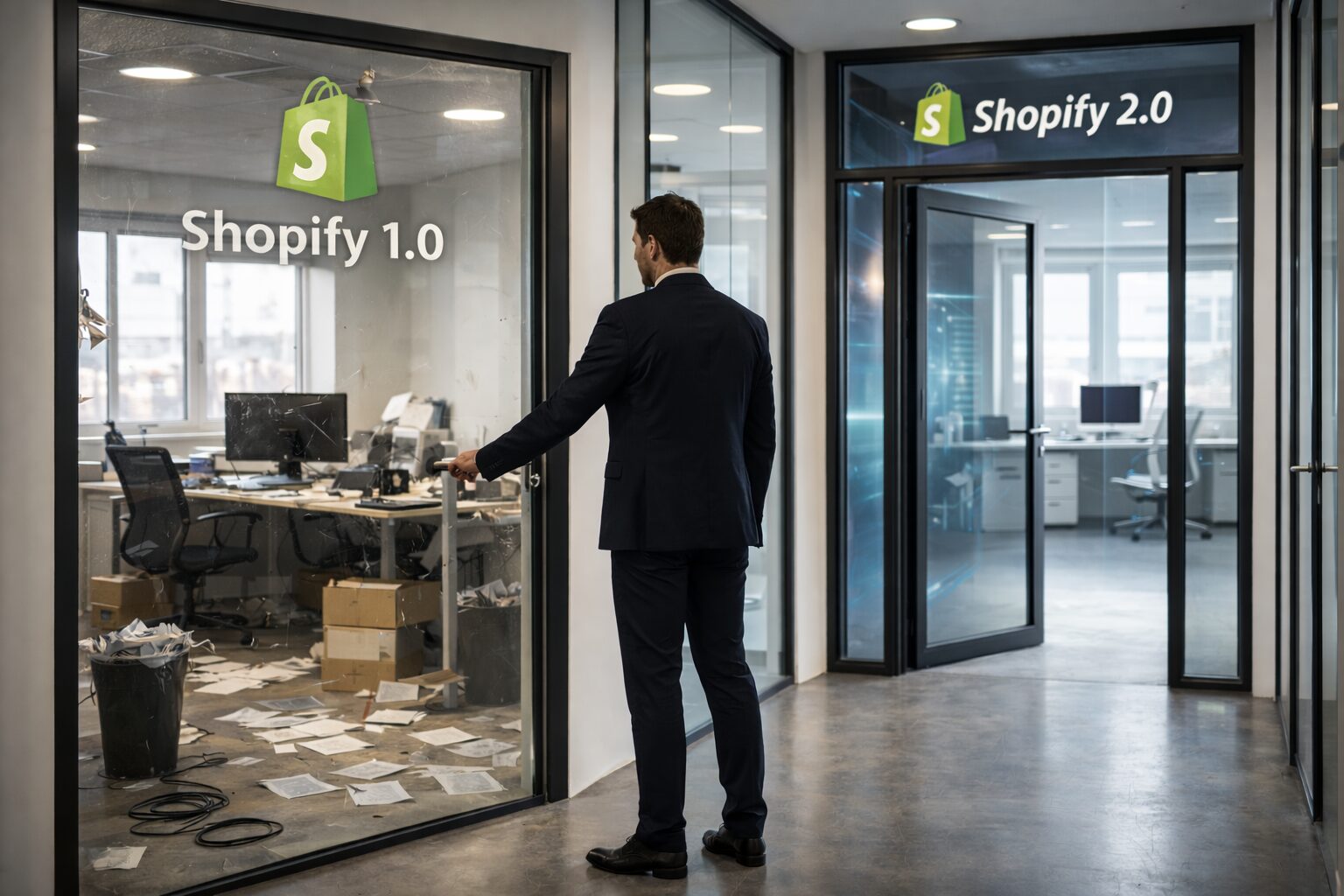
If your store is still running on Shopify 1.0, this is not a small technical detail sitting quietly in the background. It is a structural limitation that will eventually affect your growth.
Sales may still be coming in. Campaigns may still be running. Nothing may feel urgent.
But structurally, you are operating on legacy architecture.
Shopify has moved forward. The ecosystem, the apps, the performance standards, the AI layer, the internationalisation tools. Everything new is being built around Shopify 2.0.
Migration is not optional in the long term. It is inevitable. The only real decision is whether you do it strategically now or reactively later.
If you are working with a specialised Shopify Agency, this conversation should already be on the table.
What Is Shopify Online Store 2.0
Shopify Online Store 2.0 was officially released in June 2021. It was not a visual redesign. It was a fundamental rebuild of the theme architecture.
Before 2.0, Shopify themes were relatively rigid. Sections were mostly limited to the homepage. Product templates required custom coding for structural changes. Collection pages were harder to customise. Flexibility required development, and development often meant complexity.
Over time, this created technical debt.
Shopify 2.0 introduced JSON templates, sections everywhere, app blocks, metaobjects, and a modular architecture that dramatically increases flexibility. It changed how themes are structured at their core.
This architecture is now the foundation for all new Shopify innovations.
Key Benefits of Moving to Shopify 2.0
Moving to Shopify 2.0 is not just a technical upgrade. It is a structural shift that unlocks flexibility, performance, and future innovation.
Here is what truly changes.
1. Better Performance and Cleaner Architecture
Shopify 2.0 themes are built with a more modular and efficient structure.
This means:
-
Cleaner code
-
Fewer conflicts between apps
-
Easier maintenance
-
Reduced long-term development costs
Performance improvements often come naturally because the architecture is more modern. But performance alone is not the main reason to migrate.
The real value is what this structure enables.
2. Sections Everywhere = Full Design Flexibility
In Shopify 1.0, flexibility was limited. Many structural changes required custom coding.
With Shopify 2.0:
-
You can add sections to any page
-
Product templates become dynamic
-
Collection layouts are easier to adapt
-
Content blocks are modular
This dramatically reduces dependency on developers for structural changes and gives brands more control over their store experience.
3. Native Filtering and Structured Content
Shopify 2.0 introduced a proper native filtering system.
Instead of relying on heavy third-party hacks, you now get:
-
Clean faceted filtering
-
Better catalog organization
-
Structured data through metaobjects
-
Easier bundle and promotional logic
For stores with growing catalogs, this becomes essential.
4. Shopify Markets and International Growth
If international expansion is part of your strategy, 2.0 is critical.
With the updated architecture, you can:
-
Adapt content per country
-
Manage market-specific product templates
-
Structure localization properly
-
Scale without improvisation
Trying to expand globally on a rigid 1.0 structure often creates bottlenecks at the worst possible moment.
5. App Blocks and Ecosystem Compatibility
Shopify is building new features around 2.0 architecture.
Many new apps:
-
Are built primarily for 2.0
-
Offer limited support for 1.0
-
Integrate directly into sections using app blocks
The compatibility gap will continue to grow.
Staying on 1.0 means progressively limiting your access to innovation.
6. AI-Ready Infrastructure
Shopify is heavily investing in AI:
-
Personalization
-
Smart merchandising
-
Automation
-
Content generation
These systems are being built on 2.0 foundations.
Expecting long-term AI compatibility on legacy 1.0 themes is unrealistic.
7. Long-Term Code Sustainability
Many 1.0 themes rely on outdated libraries and JavaScript patterns.
Over time this creates:
-
Fragile systems
-
Unexpected bugs
-
Higher development costs
Shopify 2.0 reduces technical debt and allows cleaner development going forward.
The Real Benefit
The biggest benefit is not speed.
It is optionality.
Shopify 2.0 gives your store the flexibility to adapt, scale, integrate, and evolve without structural limitations.
And in ecommerce, structural limitations eventually become growth limitations.
Why Continuing to Invest in Shopify 1.0 Wastes Budget
This may sound strong, but strategically it is accurate.
Every dollar invested in heavy customisation on a 1.0 theme is temporary. At some point, migration will be required. When that moment comes, most of the theme layer will need to be rebuilt.
Brands often continue refining UX, improving PDP layouts, adjusting PLPs, injecting scripts, and building workarounds on 1.0. All of that effort sits on outdated infrastructure. When migration becomes necessary, much of that investment does not transfer cleanly.
If you are actively investing in CRO improvements through a professional CRO service, doing so on a legacy 1.0 structure limits the full potential of those optimisations.
Migration is not a possibility. It is an inevitability.
Imagine a store that suddenly has a strong opportunity to expand into the United States using Shopify Markets. Campaign budgets are allocated. Distribution is ready. But they discover their 1.0 theme cannot properly adapt content per market. Product templates are rigid. Filtering does not support the new catalogue structure.
Now, expansion must be postponed for two to six months while a rushed rebuild takes place.
That is not a technical inconvenience. That is lost revenue and lost momentum.
How to Migrate from Shopify 1.0 to 2.0
There is no simple button that converts a Shopify 1.0 theme into 2.0. The architecture is fundamentally different. Migration means rebuilding the theme layer.
There are two main approaches.
You can create a tailor-made custom 2.0 theme from scratch. Or you can migrate using a commercial 2.0 theme.
There is no absolute right or wrong solution. It depends on the size of the business, the complexity of the current store, and the available budget.
Option 1: Custom Shopify Theme
For high-level stores that have already invested heavily in UX and performance, a fully custom rebuild is often the best long-term solution.
This is where strong UX Design and data-driven optimisation meet technical execution.
A proper Custom theme development project allows the brand to preserve its identity while modernising its infrastructure.
Investment Required
Realistically, these projects typically range between 50,000 and 100,000 dollars when executed properly. This is not a cosmetic redesign. It is structural engineering.
How the Rebuild Is Structured
The process normally starts with CRO analysis. UX designers refine the journey. Developers rebuild the architecture in Shopify 2.0. QA ensures performance and stability.
This is where working with a specialised Shopify agency becomes critical.
Final Result
The result is a fully tailored Shopify store optimised for conversion, performance, and long-term scalability.
Option 2: Commercial Shopify Theme
For smaller or mid-size stores, using a commercial 2.0 theme is often the most efficient option.
A professional Theme setup ensures the foundation is chosen and configured correctly.
If deeper changes are required, structured Theme customization can extend the theme without compromising its core architecture.
Investment Required
Projects in this range can start around 2,500 dollars and reach up to 15,000 dollars, depending on the customisation level.
How the Rebuild Is Structured
The most important step is theme selection. The wrong foundation creates long term limitations. The right one unlocks scalability.
After selection, the setup process begins, followed by configuration and eventual structured customisation.
Final Result
The result is a modern Shopify store built on 2.0 architecture with access to current features and future platform evolution.
Publishing the New Shopify 2.0 Theme
The new 2.0 theme is developed offline and does not affect the live store during construction. When everything is ready, it is published.
Preparation is essential. Product templates, collection structures, filtering logic, and structured content must be mapped carefully.
Downtime
In most cases, downtime is limited to a few hours. With proper planning, disruption is minimal.
Timeline
A fully custom 2.0 rebuild typically requires around one month for design and three to four months for development.
A commercial theme setup usually takes around four weeks on average.
In both scenarios, you must account for a content replacement stage. This is not data migration. It is the phase where the final product images, real copy, collection banners, and structured content are placed into the new 2.0 theme.
This stage can take between one and three weeks, depending on catalogue size and internal readiness.
Underestimating this phase is a common mistake. The theme may be technically complete, but until real content is properly placed and reviewed, the store is not ready to go live.
Who Should Handle a Shopify 1.0 to 2.0 Migration
Migrating from Shopify 1.0 to 2.0 is not a superficial update. It is a structural rebuild that impacts performance, scalability, marketing flexibility, and long-term growth.
It should be handled by experienced Shopify specialists who understand architecture, UX, CRO, and business strategy.
Because your theme is not just design.
It is the operational backbone of your store.
And that backbone determines how far you can grow.
Shopify Insights & Expert Tips
We put a lot of effort into sharing what we learn from the e-commerce world. By following our blog, you’ll get valuable, niche insights straight from our experts, who genuinely enjoy dedicating their time to help others through these articles.
Visit our Shopify Blog for more insights.
Author: MM Shopy Devs - Shopify Agency
MM Shopy Devs is a Shopify and Shopify Plus agency working with fashion and lifestyle brands at every stage of growth.
From emerging labels launching their first collection to established brands scaling internationally, we help turn e-commerce into a structured, high-performing growth channel.
Our work combines UX design, conversion optimisation and technical Shopify expertise to create websites that are not only visually strong, but commercially effective.
Whether you are refining your brand, improving performance, or preparing to scale, we focus on building e-commerce experiences that balance identity with measurable results.