
Choosing a Shopify agency shapes more than the project itself. Whether you're planning a migration, redesigning your store, opening new markets or trying to get more out of the store you already have, the partner you pick decides what gets built and what the months of building it feel like.
A lot of brands assume bigger is safer. A large agency has more people, more departments and a client list that looks good in a pitch deck. But size on its own tells you very little about fit.
Large and small agencies tend to be built for different problems. Some projects need a lot of people, a lot of coordination and a lot of process. Others need a few senior specialists, quick decisions and someone who notices the details. So rather than asking which model is better, ask which one fits the problem your business has right now.
A quick disclosure before we start: we're a small agency ourselves. We've tried to be fair to both sides, and there are projects where we'd tell you to hire a big one.
What we mean by a small Shopify agency
In this article, a small Shopify agency is a specialist team of roughly 4 to 25 people. Some people call them boutique agencies. A large agency means 100 people or more, split into departments: account management, project management, design, development, QA and often marketing.
A small agency sits between a freelancer and a large agency. Unlike a freelancer, it gives you several specialists across development, UX, design, CRO and strategy. Unlike a large agency, you normally work directly with the people doing the work, not through layers of management.
For a lot of growing brands, that mix of expertise, flexibility and personal attention is what they're after.
Shopify specialists vs ecommerce generalists
Specialisation is a difference people tend to overlook.
Many large ecommerce agencies built their business on several platforms: Magento, Salesforce Commerce Cloud, SAP Commerce, PrestaShop, BigCommerce and custom builds. As Shopify became one of the leading ecommerce platforms, plenty of them added it to the list.
That breadth is worth something. A team that works across platforms sees a wide range of projects and industries, and brings that experience with it.
Small Shopify agencies mostly go the other way. They put the whole business into Shopify and Shopify Plus, so their processes, tools and daily work all revolve around one platform. We've been a Shopify partner since 2017 and have built 120+ Shopify stores in that time. It's the only platform we work on.
That focus builds a deep understanding of how successful Shopify brands run, what the platform can and can't do, and which changes actually move revenue. If you've already committed to Shopify for the long term, it helps a lot to work with a team that's in it every day.
Where large Shopify agencies excel
Large agencies exist for good reasons. When a project is complex, they can bring specialists from many disciplines together and keep a big programme moving.
Complex migrations
The clearest example is a complex migration.
Moving from Magento, Salesforce Commerce Cloud, SAP Commerce, BigCommerce, WooCommerce or a custom platform is rarely just a matter of moving products and customers. These projects often involve ERP integrations, inventory systems, subscription platforms, logistics partners, payment gateways and several internal teams with their own priorities.
A large agency has the people and the specialist roles to handle all of that. Having all of them under one roof counts for a lot when a project carries serious technical or operational risk.
Launching in several markets
Selling in several countries adds currencies, languages, tax rules, fulfilment and different customer expectations. Large agencies have run these launches before and know how to coordinate the many teams involved.
Enterprise transformations
When a company is rebuilding its whole ecommerce setup rather than improving a store, a large agency often has the structure, process and capacity to run it well.
Large agencies are at their best when complexity is high and coordination is the hard part.
Where small Shopify agencies excel
Once a store is live, the priorities change. The work stops being about data migration, integrations and launch dates and starts being about commercial performance. The questions become:
- How do we lift the conversion rate?
- How do we raise the average order value?
- How do we give customers a better experience?
- How do we keep growing?
This is where a small agency adds the most value.
Custom redesigns and brand-led stores
Small agencies are at their strongest on custom redesigns, and on brands where the look and feel of the store is part of what they sell. Fashion is the obvious case.
Part of the reason is size. With fewer clients, a small agency can give each project far more attention. The other part is who does the work. In a large agency, the senior people who win the pitch often hand the build to a mixed team that includes juniors. That's a normal way to run a big company and to train people, but it means your store is partly someone's learning ground. A small agency has no one to hand it down to. The senior Shopify developers and designers who scope your project are the ones who design and build it, so you get the highest level of expertise and the full attention of the people who have it.
That matters because a redesign is not mainly a visual exercise. A good Shopify store redesign is a performance project. The gap between a redesign that looks good in a portfolio and one that grows revenue comes down to hundreds of small decisions: product card layout, mobile navigation, collection structure, filters and search, add-to-cart behaviour, trust signals, content hierarchy and the path to checkout. A senior team has made those decisions many times before, so it can spend its time testing and questioning each one instead of learning them on your store.
Two of our own projects show what that looks like. For Nude Project, a fashion brand from Barcelona, we redesigned almost every part of the store on a custom Shopify Plus build and have kept improving it since, through UX work and CRO cycles. Its yearly revenue has grown 65.2%. For Marfa Stance, a luxury fashion label from London, we moved the store off a headless setup onto a fully custom Shopify Plus theme in four months, on schedule, and its average order value rose 4.2%.
The aim is a store that sells better, not one that simply looks new.
Small improvements that add up
Growth rarely comes from one big project. It comes from dozens, sometimes hundreds, of small improvements made steadily over time.
A faster product page, a better mobile menu, sharper collection merchandising, smarter upsells, easier product discovery, one less step before checkout. None of them looks like much on its own. Together they can move revenue and margin a long way.
With fewer clients, a small agency has time to find these opportunities, rank them and keep refining them. That steady, unglamorous work is what moves day-to-day performance.
Senior people, one message away
The biggest everyday difference between small and large agencies is how communication flows.
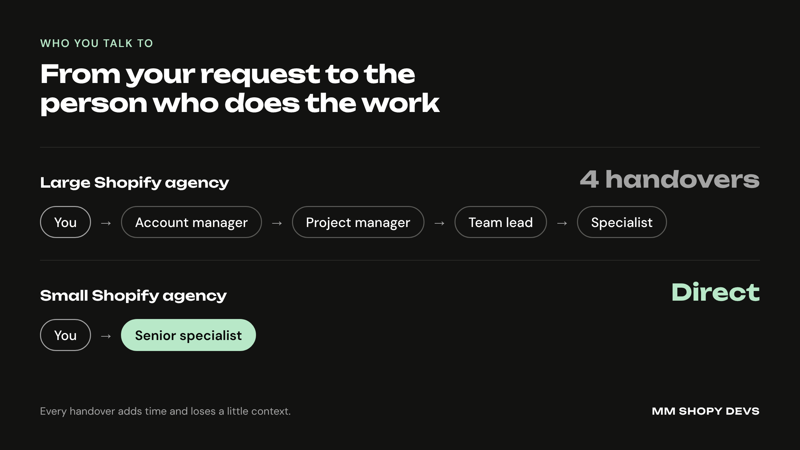
In a large organisation, a request usually passes through several people before anyone acts on it: an account manager, a project manager, a team lead, then the specialist. Each of them has a job to do, but every handover adds distance between you and the person doing the work.
In a small agency, the person on the strategy call is usually the one designing, building and optimising the store. Feedback loops are shorter, it's clear who is responsible for what, and the relationship feels more like working with part of your own team.
A fractional team: senior specialists only when you need them
Small agencies can also work in a fractional way. Instead of paying for a full team all year, you bring in senior specialists for exactly the stretch of work that needs them: a CRO specialist for a round of tests, a Shopify Plus developer for checkout extensions and Shopify Functions, a performance expert before a big campaign, a UX lead for the first weeks of a redesign. When the work is done they step back, and so does the cost.
That's harder for a large agency to offer. A big team has to be kept busy, which is one reason monthly retainers are so common. When we researched Shopify retainers, we checked 20 of the biggest Shopify development agencies in the UK and Spain. Eight of them openly sell a monthly retainer, and another nine describe themselves as a "growth partner" or "an extension of your team" without saying how that's billed. A retainer can be the right call when there's a real growth plan behind it. Without one, a fractional setup usually gets you more senior help for less money.
Knowledge that stays with your store
Many brands run into the same problem after a large project. The team that delivered the migration or redesign moves on to other accounts or departments. That's normal in a big organisation, but valuable context gets lost along the way.
Small agencies tend to keep the same specialists on an account for years. Instead of handing knowledge from team to team, the agency keeps learning about your business, your customers and your goals. Over time, that knowledge becomes one of the most valuable parts of the relationship.
AI is making Shopify work cheaper. Who keeps the saving?
AI has changed how quickly a lot of development work gets done. In a controlled study run by GitHub, 95 professional developers were asked to build the same small web server. The group using Copilot took 1 hour 11 minutes on average, against 2 hours 41 minutes for the group without it: 55% faster. McKinsey found developers can finish some coding tasks up to twice as fast with generative AI, with smaller gains on complex work.
We see it in our own numbers. A standard theme section that isn't especially complex, such as a hero or a parallax block with an image and text, used to take us 5.5 hours. Today it takes a flat 2 hours, and that includes the architecture, the automated QA and a person checking it by eye. That's almost two thirds less time on every section. Migration scripts, data clean-up and translations take less time too. The judgement hasn't gone anywhere: someone still decides what to build and reviews every section, and that review is inside the 2 hours. We wrote about that balance in how we take Figma designs to production with Claude.
Which raises a simple question: who keeps the saving? Take a custom theme with 20 standard sections. At 3.5 hours saved on each, that's 70 hours. Someone keeps them.
In a large agency, the answer depends on the cost base. Offices, account and project managers, sales teams and utilisation targets all have to be paid for, and billable hours are what pay for them. Fewer hours on the same structure means less revenue, so the saving tends to go into margin, or into keeping day rates where they are. Nobody is being greedy here; that's simply how a big service business balances its books.
A small agency doesn't have that machine to feed. With a lean team and little overhead, it can pass the saving straight on to the client: fewer hours on the invoice, a lower project quote, or more work done for the same budget. That's how we work: when a section takes us 2 hours instead of 5.5, the quote is built on the 2, and the saving comes off the project cost instead of going into our margin.
Lower cost shouldn't mean lower quality, though. The time AI saves on writing code goes back into the parts that matter most: reviewing, testing and getting the details right. And if you'd like to use AI across your own business as well, our guide on how to use AI to cut ecommerce costs covers that side.
Why many brands move to a smaller agency after a migration
There's a pattern across the Shopify ecosystem: many brands hire a large agency for the migration and move to a smaller one afterwards. Not because the migration went wrong, but because the business needs something different once the store is live.
Before launch, success means delivering the migration, managing technical risk, keeping stakeholders aligned and launching on time. After launch, it means a higher conversion rate, a better customer experience, a bigger average order value, new features and steady optimisation.
The agency best equipped to handle complexity isn't always the one best placed to drive growth for the next five years. So as priorities change, many brands look for a partner who can give performance more of its attention.
Where freelancers fit
Freelancers are still a great option for startups, smaller stores and one-off jobs. If you need a simple theme tweak or a small development task, an experienced freelancer is often the fastest and cheapest way to get it done.
As a brand grows, though, development, UX, CRO, design, strategy, integrations and support start to depend on each other. At that point, many businesses find that a small Shopify agency gives them the right balance of specialist skill and personal attention.
Large agency vs small agency at a glance
| Area | Large Shopify agency | Small Shopify agency |
|---|---|---|
| Built for | Complexity and coordination | Performance and growth |
| Strongest at | Complex migrations, multi-market launches, enterprise programmes | Custom redesigns, CRO, ongoing development |
| Platforms | Often several | Usually Shopify only |
| Who works on your project | Large multidisciplinary teams, mixed seniority | Small teams of senior specialists |
| Who you talk to | Account and project managers | The people doing the work |
| Ongoing work | Often a monthly retainer | Project by project, or specialists brought in when needed |
| AI savings | Often absorbed by a larger cost base | Can go straight to the client as a lower project cost |
Which one should you choose?
A large agency may be the right choice if you're planning a complex migration, selling across several markets, dealing with heavy technical complexity or running a company-wide transformation.
A small Shopify agency may be the right choice if your focus is growth, conversion, ongoing development or a custom redesign, if you want senior people working on your store and talking to you directly, or if you'd rather bring in specialists when you need them than pay a large team every month.
Plenty of brands use both, at different stages. The right choice depends on the problem you're trying to solve today.
If you're weighing this up for your own store, tell us what you're planning and we'll give you a straight answer, even if that answer is a bigger agency.